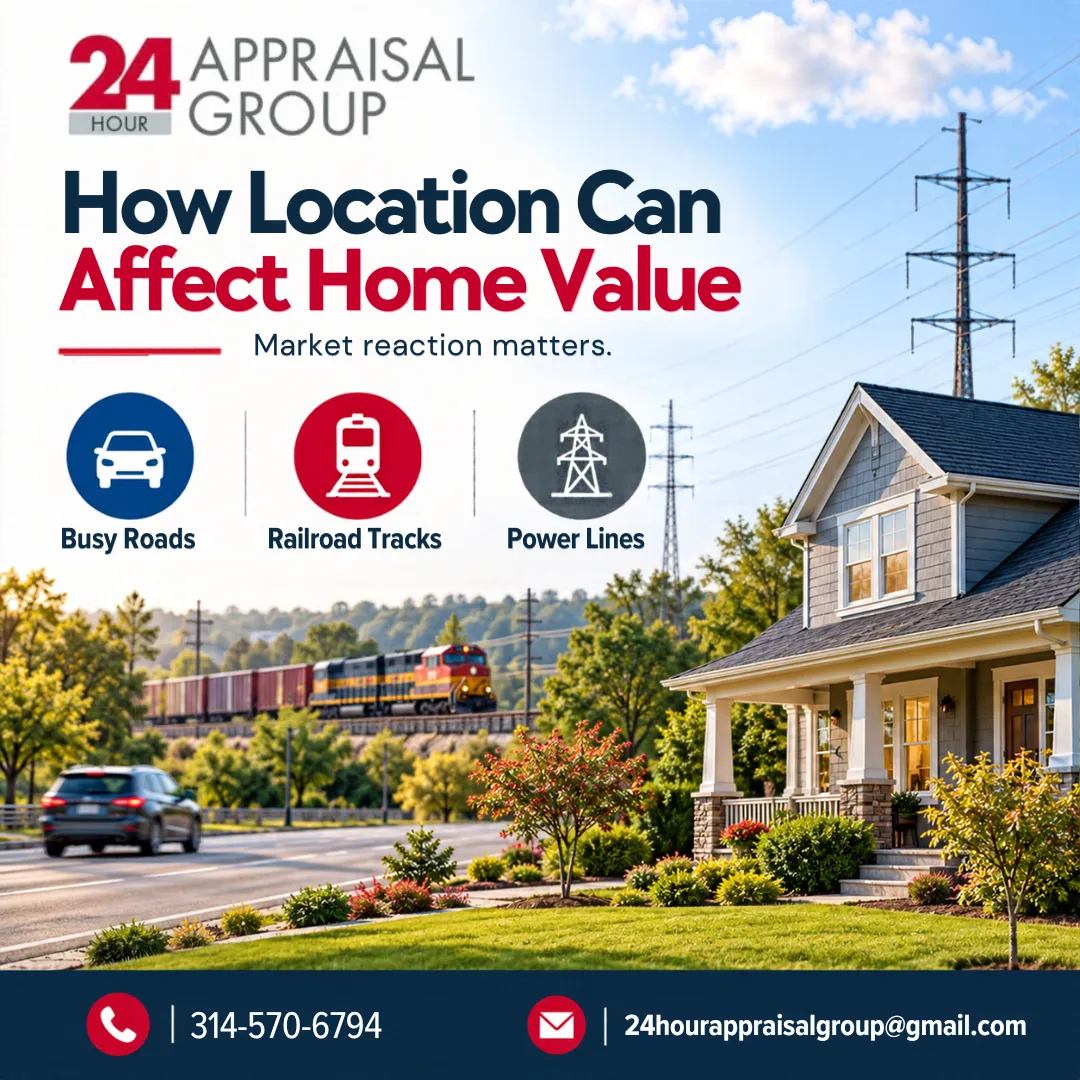
Does Living Near a Busy Road, Railroad, or Power Lines Affect Home Value in St. Charles County?
It can.
A home’s value is influenced by more than its size, condition, and upgrades. Location-related factors outside the property itself can also affect how buyers respond to a home.
That may include being near:
A busy road
Railroad tracks
High-voltage power lines
Commercial property
Heavy traffic
Other external influences
The presence of one of these features does not automatically mean the property will lose a specific amount of value.
The real question is:
How does the local market react to it?
Own a property near a busy road, railroad, or other unusual location feature?
[Discuss Your Property With an Appraiser]
Why External Location Factors Matter
Buyers do not evaluate a house in isolation.
They also consider what surrounds it.
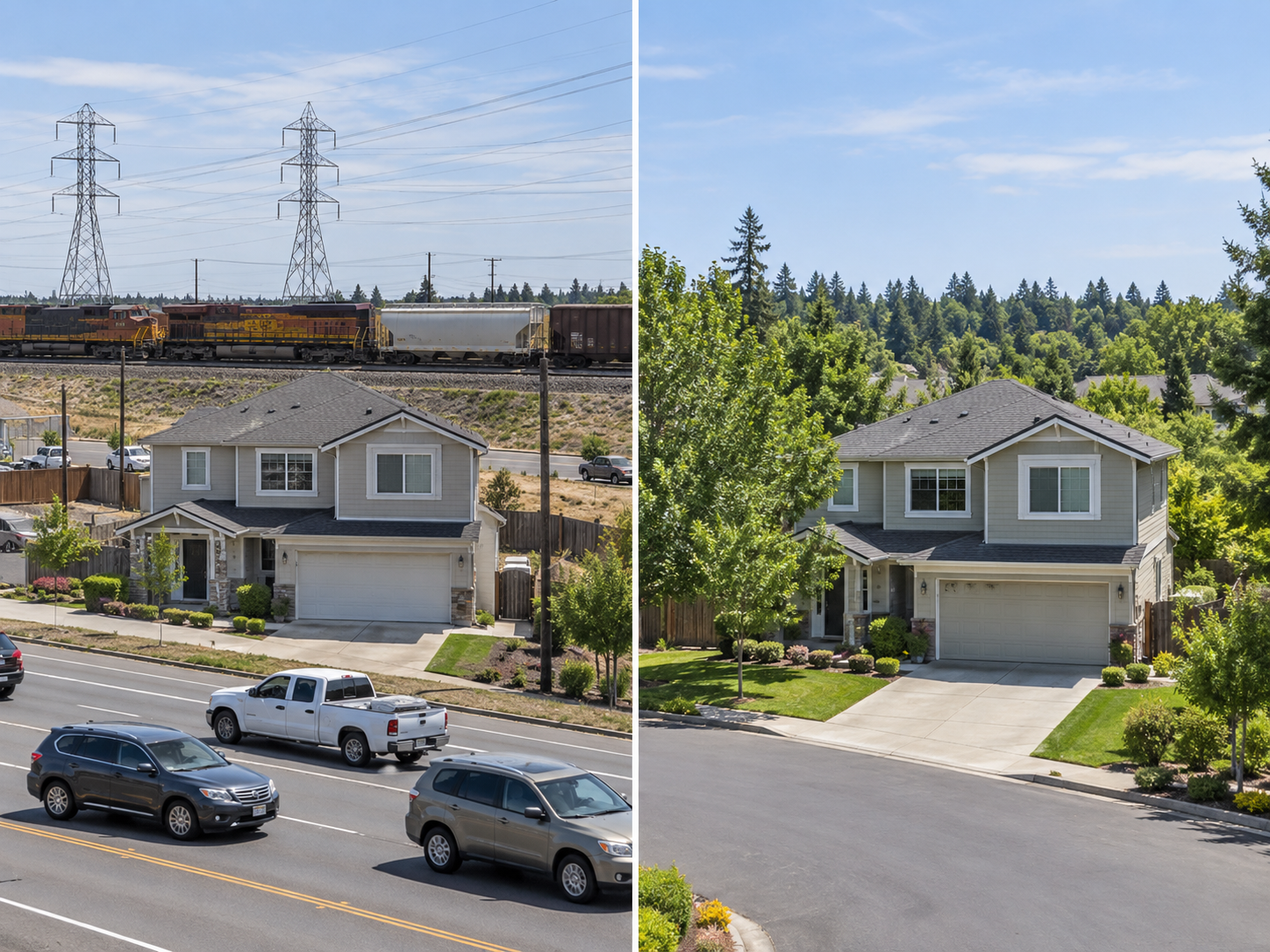
For example, two nearly identical homes may have different market appeal if one sits on a quiet residential street and the other backs to a heavily traveled road.
An appraiser looks for evidence showing whether buyers are paying differently for properties affected by that location factor.
How Does a Busy Road Affect an Appraisal?
A busy road may affect:
Noise
Privacy
Traffic
Driveway access
Outdoor enjoyment
Buyer demand
But the effect is not the same in every neighborhood.
In some areas, buyers may strongly prefer interior streets. In others, being near a major road may be common enough that the market reaction is smaller.
That is why an appraiser cannot simply apply a standard “busy road deduction.”
The adjustment must be supported by market evidence.
What About Railroad Tracks?
Railroad proximity may create concerns about:
Train noise
Vibration
Frequency of train traffic
Safety perception
Overall buyer appeal
Again, the distance matters.
A home several blocks away from railroad tracks may not be viewed the same as one directly backing to them.
An appraiser looks at how comparable homes with similar influences are actually selling.
Do High-Voltage Power Lines Affect Value?
They can influence buyer perception, but the effect varies.
Some buyers may avoid properties near large transmission lines, while others may be less concerned.
The appraiser may consider:
Distance from the lines
Visibility
Easements
Similar nearby sales
How long affected properties remain on the market
Whether buyers appear to pay less
There is no universal percentage adjustment that applies to every property.
The market—not a fixed formula—determines whether the feature contributes to a measurable difference in value.
[Get Professional Valuation Guidance]
How Does an Appraiser Measure the Impact?
The strongest evidence usually comes from comparable sales.
An appraiser may compare:
Affected properties
Homes near the same road, railroad, or power-line influence
with
Unaffected properties
Similar homes without that influence
The goal is to determine whether the market consistently shows a difference.
Sometimes the effect is clear.
Other times, the data may show little measurable impact.
The Closest Comparable Is Not Always the Best Comparable
This is especially important with location issues.
A home two streets away may look similar but may not experience the same traffic, noise, or external influence.
An appraiser may need to search farther away to find a property with a similar location challenge.
The most useful comparable is not always the closest sale—it is the one that best helps explain how the market reacts to the subject property.
Why Online Estimates May Miss These Differences
Automated valuation tools can analyze property records and nearby sales, but they may not fully capture:
Traffic intensity
Noise
Views of power lines
Railroad proximity
Privacy
Access issues
Buyer resistance
That can make unusual-location properties harder to value using an automated estimate alone.
A professional appraisal allows the appraiser to evaluate both the property and its surroundings.
Jacob’s Experience With Location-Sensitive Properties
Jacob Geringer is a Certified Residential Appraiser with more than 26 years of local real estate experience.
That experience is particularly useful when a home has a feature that does not fit neatly into a typical subdivision comparison.
The goal is not to assume a penalty.
It is to determine whether the local market supports one.
When Should You Consider an Appraisal?
A professional appraisal may be useful if your property:
Backs to a busy road
Is near railroad tracks
Is close to high-voltage power lines
Has an unusual location
Receives inconsistent online estimates
Is difficult to compare with nearby homes
Needs an independent value for an estate, private transaction, refinance, or other financial decision
Get a Property-Specific Opinion of Value
If your home in St. Charles, O’Fallon, St. Peters, Wentzville, Lake St. Louis, or the greater St. Louis Metro Area is affected by a busy road, railroad, power lines, or another external influence, the impact on value should be based on actual market evidence.
A professional appraisal can help determine how buyers appear to respond to that specific location.
Get a valuation based on your property, your location, and the local market.
[Discuss Your Appraisal Needs]
Frequently Aasked Question Section
Does a busy road always lower a home’s appraised value?
No. The effect depends on buyer reaction and comparable sales in that market. Some properties may show a measurable difference, while others may not.
How do appraisers adjust for railroad tracks?
Appraisers analyze comparable properties with similar railroad exposure and look for evidence of how the market responds to the noise, proximity, and other influences.
Do power lines automatically reduce home value?
Not automatically. Their effect depends on visibility, proximity, easements, local buyer perception, and market evidence.
Can an appraiser use a comparable farther away?
Yes. A farther comparable may be more useful if it shares a similar location influence that nearby properties do not.
Can an online estimate account for road noise or railroad proximity?
Sometimes only partially. Automated models may not fully capture property-specific external influences, which is one reason unusual-location homes may benefit from a professional appraisal.
