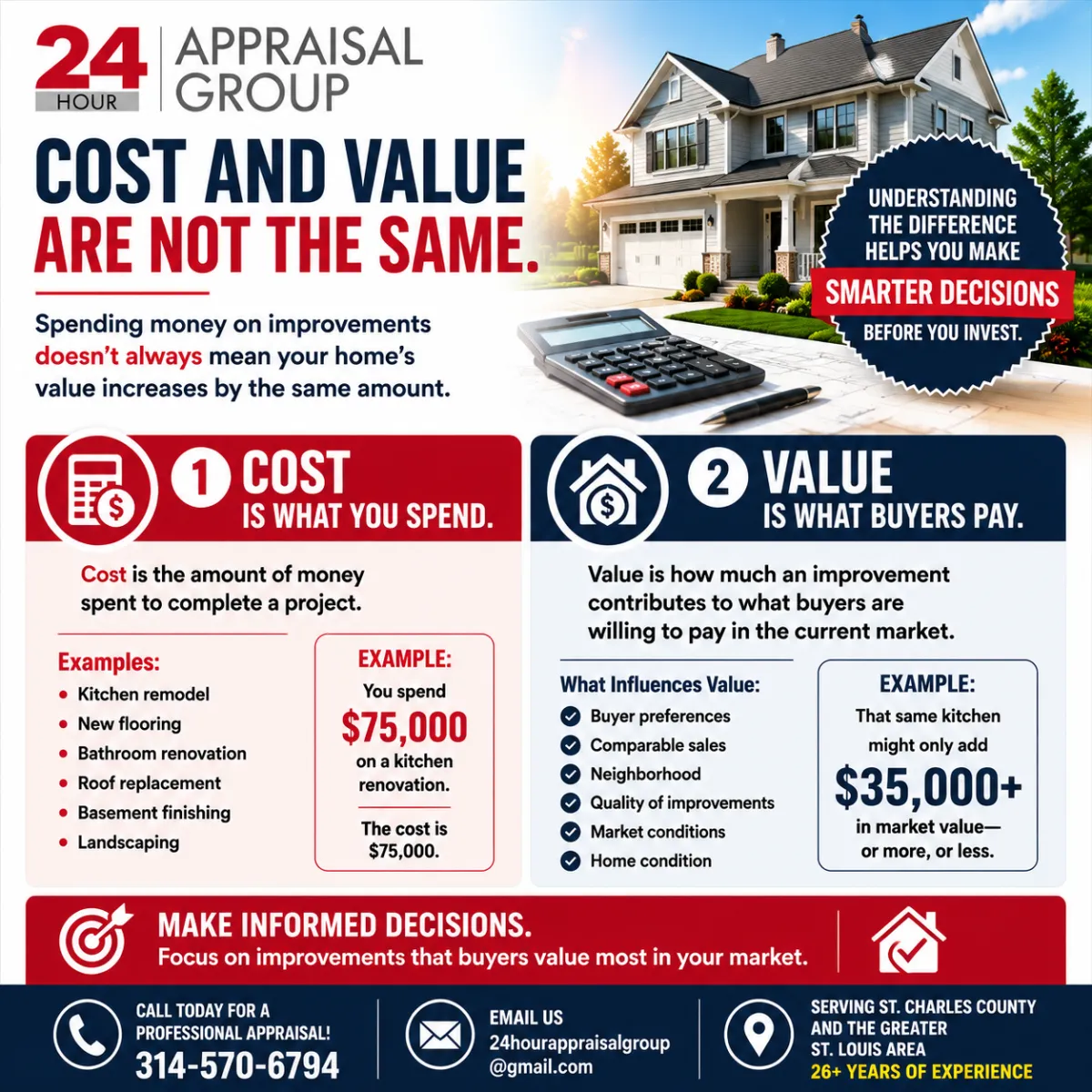
The Difference Between Cost and Value: Do Home Improvements Really Increase Value?
By a St. Charles County Certified Residential Appraiser
One of the most common questions I hear from homeowners is:
"If I spend $50,000 on improvements, won't my home be worth $50,000 more?"
It's a reasonable assumption—but the answer is not always yes.
After more than 26 years of appraising residential properties throughout St. Charles County and the Greater St. Louis area, I've learned that one of the biggest misunderstandings homeowners have is confusing cost with value.
While the two terms are related, they are not the same.
Understanding the difference can help homeowners make smarter decisions before investing money into repairs, renovations, or upgrades.
What Is Cost?
Cost is the amount of money spent to complete a project.
Examples include:
Kitchen remodeling expenses
New flooring installation
Bathroom renovations
Roof replacement
Landscaping improvements
Basement finishing
Home additions
Cost answers the question:
"How much did this improvement require me to spend?"
For example:
A homeowner spends $75,000 remodeling their kitchen.
The cost of the project is $75,000.
However, that does not automatically mean the home's market value increased by $75,000.
What Is Value?
Value represents how much a feature or improvement contributes to what buyers are willing to pay for a property.
Value answers a different question:
"How much is this improvement worth in the current market?"
The market—not the homeowner—determines value.
A homeowner may personally appreciate a renovation, but buyers may not value every improvement the same way.
This is where professional valuation experience becomes important.
Why Cost and Value Are Often Different
One of the biggest mistakes homeowners make is assuming:
Cost = Added Value
In reality:
The amount spent does not always equal the amount added to market value.
For example:
A homeowner spends $100,000 creating a luxury kitchen.
The renovation may improve the home's appeal, but if buyers in that price range are not willing to pay significantly more for that feature, the full cost may not be reflected in the home's value.
On the other hand, a smaller improvement—such as replacing outdated flooring or addressing deferred maintenance—may create a stronger return because it improves buyer confidence.
Not All Improvements Add the Same Value
Different projects affect value differently.
Improvements That May Help Marketability
Some improvements can make a home more attractive to buyers, such as:
Fresh paint
Updated flooring
Improved curb appeal
Modern fixtures
Addressing obvious maintenance issues
Cleaning and improving presentation
These improvements may help buyers see the property more positively.
Improvements That May Not Return the Full Cost
Some upgrades may be highly personal or exceed what buyers expect in the neighborhood.
Examples:
Extremely high-end finishes
Overly customized rooms
Luxury upgrades beyond neighborhood standards
Expensive features with limited buyer demand
A homeowner may enjoy these improvements, but the market may not recognize the full expense.
The Neighborhood Matters
A common mistake homeowners make is improving a home without considering the surrounding market.
A $100,000 kitchen renovation may have a different impact depending on:
Neighborhood price range
Buyer expectations
Comparable homes
Local demand
Current market conditions
A feature that adds significant value in one neighborhood may provide a smaller return in another.
This is why local market knowledge matters.
Why Appraisers Look at Contribution, Not Just Cost
When completing an appraisal, I do not simply look at how much money was spent.
I evaluate how the market responds to those improvements.
The key question is:
"How much does this feature contribute to the property's market value?"
Appraisers analyze factors such as:
Comparable sales
Buyer preferences
Quality of improvements
Condition differences
Market trends
Neighborhood expectations
The goal is to determine how the market views the improvement—not how much the homeowner invested.
Why This Matters Before Selling a Home
Before putting a home on the market, many homeowners ask:
Should I remodel the kitchen first?
Should I replace the flooring?
Should I finish the basement?
Should I make repairs before selling?
Will I get my money back?
The answer depends on the property.
Some improvements can increase buyer interest and value.
Others may simply make the home more enjoyable to live in without providing a matching financial return.
Understanding the difference between cost and value can help homeowners avoid spending money in areas that may not provide the expected benefit.
This Is Especially Important for Inherited Properties
Inherited homes often create difficult decisions.
Families may wonder:
Should we renovate before selling?
Should we fix everything?
Should we sell as-is?
In these situations, understanding cost versus value becomes even more important.
Spending thousands of dollars on improvements does not always make financial sense, especially if the most likely buyers would purchase the property for other reasons.
A professional opinion can help families determine which improvements may matter and which may not.
Experience Makes a Difference
After appraising thousands of homes over more than two decades, I've learned that every property has its own story.
The same improvement can have different results depending on:
Location
Market conditions
Buyer demand
Property condition
Neighborhood expectations
Real estate value is not determined by a receipt or renovation budget.
It is determined by how the market responds.
The Bottom Line
Cost and value are connected—but they are not the same.
The amount you spend on a home improvement does not automatically equal the amount it adds to your property's market value.
Before investing in renovations, repairs, or upgrades, homeowners should understand what improvements are likely to provide meaningful value in their specific market.
An informed decision starts with accurate information.
Need Help Understanding Your Property's Value?
At 24 Hour Appraisal Group, we provide professional residential appraisals throughout St. Charles County and the Greater St. Louis area.
Whether you need an appraisal for pre-listing decisions, inherited property, probate, estate settlement, divorce, tax purposes, refinancing, or other valuation needs, we help homeowners understand what their property is truly worth.
With more than 26 years of local appraisal experience, we provide objective opinions of value based on market data, comparable sales, and professional analysis.
Contact 24 Hour Appraisal Group today to schedule a professional appraisal you can trust.
