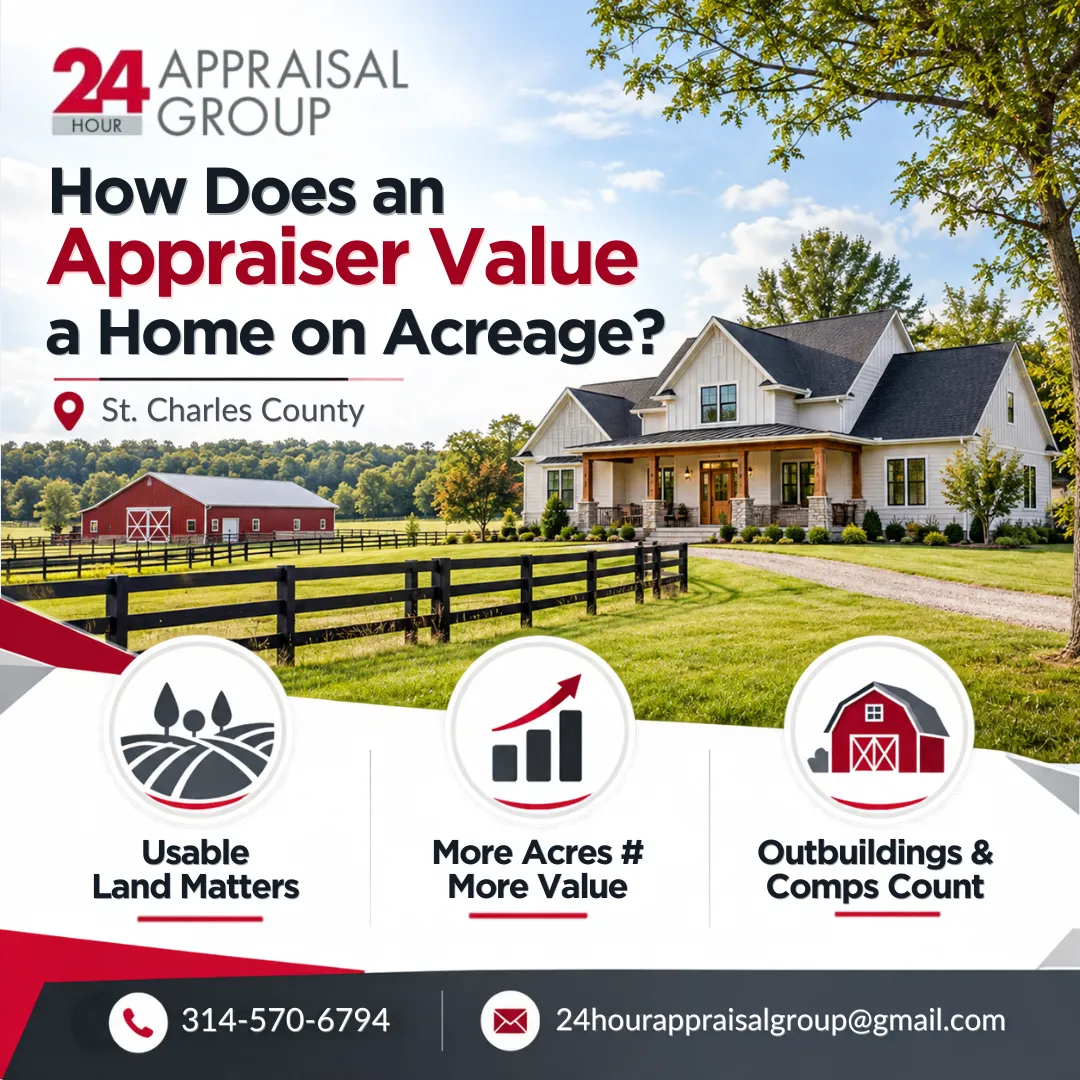
How Does an Appraiser Value a Home on Acreage in St. Charles County?
Owning more land can add value to a property, but acreage is not valued by simply multiplying the number of acres by a fixed price.
For homes on acreage in St. Charles County, an appraiser looks at the property as a whole, including the house, the land, the quality and usability of that land, additional improvements, and how similar properties are performing in the market.
That means a five-acre property is not automatically worth twice as much as a similar home on 2.5 acres.
Own a home with acreage and want a clearer idea of its market value?
[Discuss Your Property With an Appraiser]
What Does an Appraiser Look at First?
When evaluating a residential property with acreage, the appraiser considers both the home and the land.
Important factors can include:
Size and condition of the home
Total acreage
Usable versus difficult-to-use land
Topography
Road access
Utilities
Location
Privacy
Outbuildings
Fencing
Recent comparable sales
How buyers in the area react to larger lots
Acreage matters, but not every acre contributes the same amount of value.
Does More Land Always Mean More Value?
Usually, additional land can contribute value, but the contribution may decrease as the acreage increases.
For example, the difference between one acre and three acres may be very meaningful to buyers.
The difference between 18 acres and 20 acres may not create the same increase in value.
This is sometimes referred to as diminishing contributory value.
The key question is not simply:
“How many acres does the property have?”
It is:
“How much value does the market place on that additional land?”
Usable Acreage Matters
Two properties can have the same number of acres and still have very different values.
One may have open, level, usable land with good access.
Another may include steep slopes, heavily wooded areas, drainage issues, floodplain, or portions that are difficult to use.
An appraiser looks at how useful the land is and how similar properties are viewed by buyers.
That can be particularly important in areas outside more traditional subdivisions in Wentzville, Lake St. Louis, Defiance, Foristell, or other parts of St. Charles County.
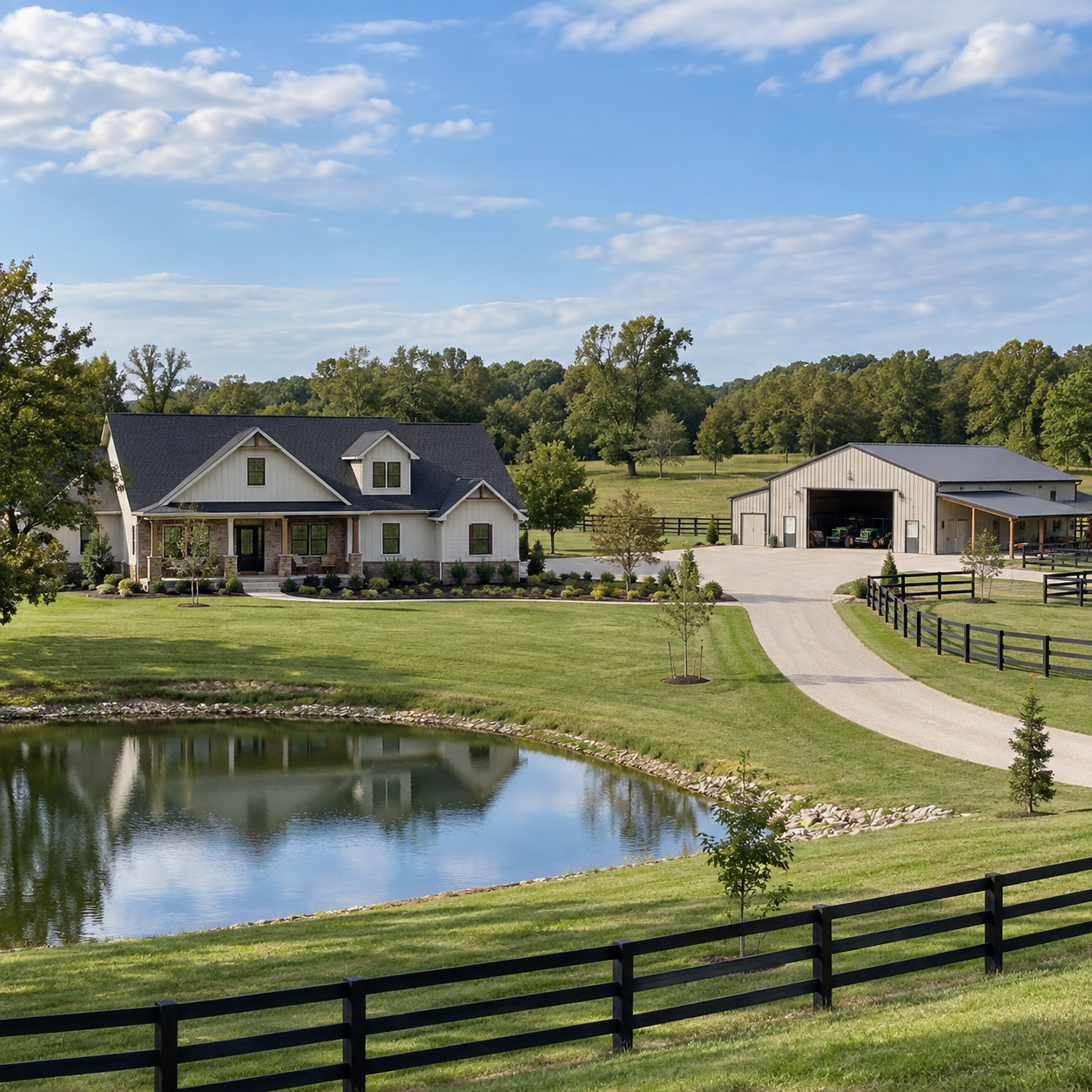
What About Barns, Workshops, or Other Outbuildings?
Additional structures can contribute value, but their value depends on more than what they cost to build.
An appraiser may consider:
Size
Condition
Quality of construction
Utility
Electrical service
Heating
Access
Typical buyer demand
A large workshop may be highly desirable on one acreage property but less important in another market.
If your property includes acreage, barns, workshops, or other features that make it difficult to compare, a professional appraisal can help provide a property-specific opinion of value.
How Are Comparable Sales Chosen?
Finding good comparable sales can be more challenging for acreage homes.
The appraiser may need to look farther away than they would for a typical subdivision property.
The goal is not simply to find the closest sale.
It is to find properties that are reasonably similar in:
Acreage
Home size
Age
Quality
Condition
Location
Outbuildings
Overall utility
Sometimes a comparable several miles away may provide better market evidence than a nearby home on a small subdivision lot.
Why Cost Does Not Equal Market Value
A homeowner may spend a significant amount on fencing, a barn, driveway improvements, landscaping, or other property features.
That does not necessarily mean the market value increases by the same amount.
Appraisal value is based on how the market responds to those improvements, not simply what they cost.
That is why acreage properties often require more analysis than standard homes with highly similar nearby sales.
Experience Matters With Acreage Properties
Jacob Geringer is a Certified Residential Appraiser with more than 26 years of local real estate experience.
Properties with acreage often require careful analysis of land characteristics, comparable sales, outbuildings, location, and buyer demand.
The objective is to develop a value opinion based on market evidence rather than a simple per-acre formula.
When Should You Consider an Appraisal?
A professional appraisal may be useful if you:
Own a home with several acres
Are planning a private sale
Need an estate or probate valuation
Are considering refinancing
Have significant outbuildings
Are preparing for a financial decision
Have received conflicting online estimates
Own a property that does not compare easily with nearby homes
Get a Clearer Picture of Your Acreage Property’s Value
If you own a home with acreage in St. Charles County or the greater St. Louis Metro Area, your property may require more detailed analysis than a typical subdivision home.
A professional appraisal can help evaluate the house, land, improvements, and market evidence together.
Get a valuation based on your specific property—not just acreage alone.
[Discuss Your Appraisal Needs]
Frequently Asked Question
Does every acre add the same amount of value?
No. Additional acreage can contribute value, but not necessarily at the same rate. The usefulness of the land and how the market reacts to it matter.
Is wooded land worth less than open land?
Not always. Some buyers value wooded acreage for privacy and recreation, while others prefer open usable land. The contribution depends on local buyer preferences and market evidence.
Do barns and workshops add value?
They can, especially when they are functional, well-built, and desirable to buyers in that market. However, the added value may not equal the construction cost.
Can an appraiser use comparable sales from farther away?
Yes. For acreage properties, a comparable farther away may be more relevant if it is more similar in land size, home characteristics, and overall utility.
Are online estimates accurate for homes with acreage?
They can provide a rough reference, but acreage properties can be harder for automated valuation tools to evaluate because land usability, outbuildings, condition, and property-specific features may not be fully captured.
