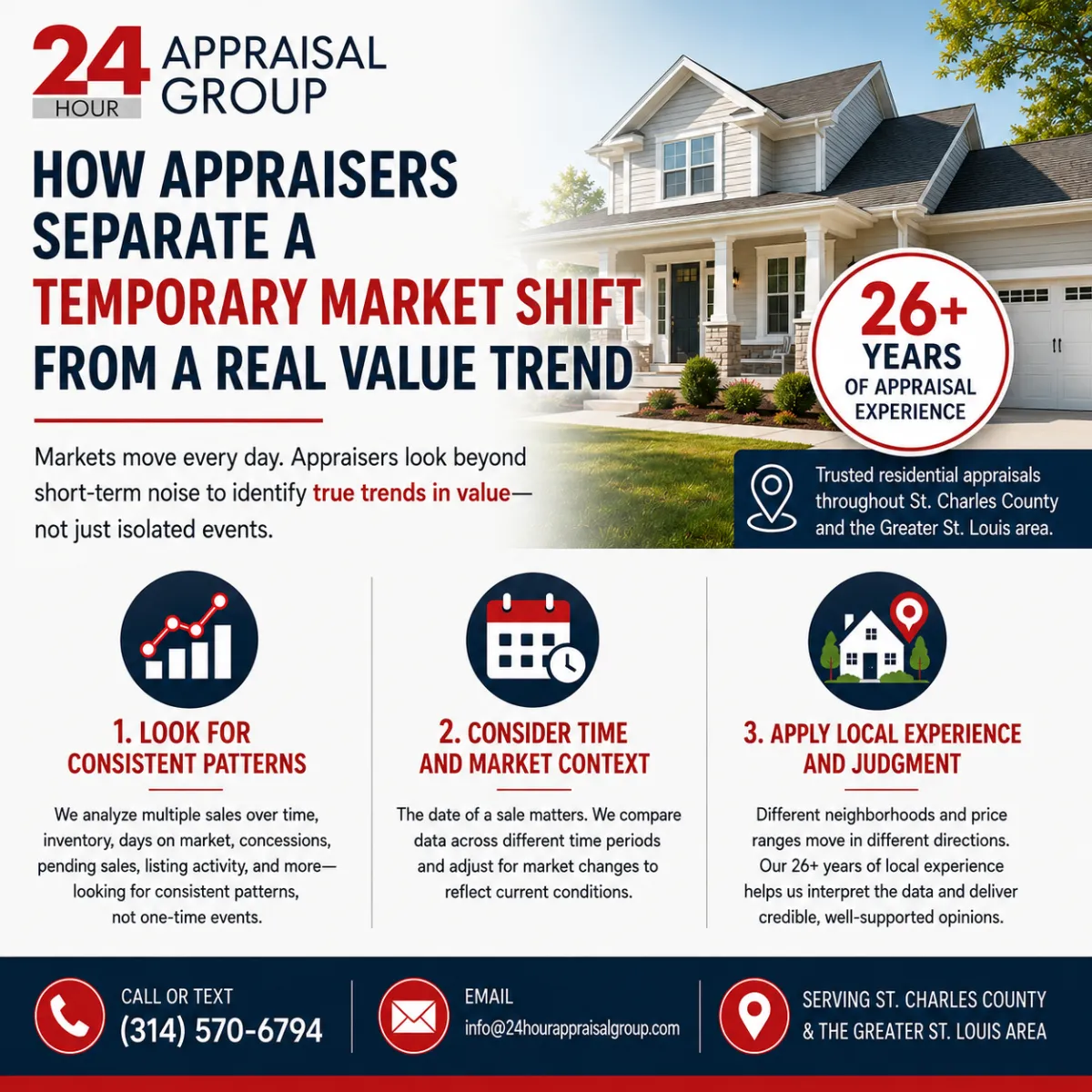
How Appraisers Separate a Temporary Market Shift From a Real Value Trend
By a Certified Residential Appraiser Serving St. Charles County and the Greater St. Louis Area
Real estate markets are constantly moving.
Interest rates change. Inventory rises and falls. Buyer activity increases during certain times of the year. A few homes may suddenly sell above asking price—or several listings may sit longer than expected.
When homeowners see these changes, one question often follows:
“Is the market actually changing, or is this just temporary?”
After more than 26 years appraising residential properties throughout St. Charles County and the Greater St. Louis area, I’ve learned that answering that question requires more than looking at a few recent sales.
Appraisers have to determine whether the data represents a short-term fluctuation or evidence of a broader change in market value.
That distinction can have an important impact on an appraisal.
One Sale Doesn’t Establish a Trend
Suppose three similar homes recently sold for around $400,000.
Then another property sells for $430,000.
Does that mean values suddenly increased by 7.5%?
Not necessarily.
That sale could have been influenced by:
Superior condition
Significant renovations
A particularly desirable lot
Multiple competing offers
Seller concessions or financing terms
Limited inventory at the time of sale
Unique buyer motivation
An appraiser doesn’t automatically treat one unusually high—or low—sale as evidence that the entire market has changed.
Instead, we look for patterns across multiple transactions and other market indicators.
Temporary Market Shifts Happen
Real estate activity can change temporarily without creating a lasting change in property values.
Seasonality is a good example.
Buyer activity may increase during certain parts of the year and slow during others. Inventory can temporarily tighten. A sudden increase in demand may create stronger competition for a limited number of homes.
Economic news or changes in mortgage rates can also cause buyers to temporarily accelerate or delay their plans.
Those changes matter, but they don’t automatically establish a long-term trend.
The appraiser's job is to determine whether the change is isolated—or whether the market is consistently moving in a new direction.
Real Trends Usually Leave More Than One Clue
When a residential market is genuinely appreciating or declining, the evidence usually appears in several places.
Appraisers may examine:
Sale prices over time
Price trends among similar properties
Days on market
Listing activity
Inventory levels
Sale-to-list price relationships
Seller concessions
Pending sales
Competing listings
Buyer demand
No single indicator necessarily tells the whole story.
But when several indicators begin pointing in the same direction, the evidence becomes much stronger.
For example, rising sale prices combined with shorter marketing times, limited inventory, and stronger buyer competition may indicate genuine appreciation.
Conversely, declining prices combined with longer marketing periods, increasing inventory, more concessions, and repeated price reductions may suggest weakening market conditions.
Comparable Sales Need to Be Viewed in Time
Appraisers don't only ask:
“What did this comparable sell for?”
We also ask:
“When did it sell, and what was happening in the market at that time?”
This becomes particularly important in a changing market.
Imagine a comparable property sold nine months ago for $450,000.
If market evidence indicates that similar properties have appreciated since then, its sale price may not represent the same market conditions that exist on the appraisal's effective date.
The reverse can also happen in a declining market.
This is why the date of sale matters.
When market conditions have changed, an appraiser may analyze whether a market conditions adjustment, sometimes informally called a time adjustment, is supported by the available data.
The adjustment shouldn't be based on assumption. It should be supported by market evidence.
Pending Sales Can Provide Important Clues
Closed sales tell us what buyers were willing to pay in the recent past.
Pending sales can sometimes provide insight into what buyers are doing now.
The final contract price may not always be publicly available while a property is pending, but the activity itself can still provide useful context.
For example:
How quickly did the property go under contract?
Was the listing price recently reduced?
How does it compare with active competition?
Are similar properties consistently going pending quickly?
When several comparable properties show similar patterns, those observations can help an appraiser understand the direction of current buyer activity.
Active Listings Show the Competition
Active listings aren't completed transactions, so they don't provide the same evidence as closed sales.
But they still matter.
They show what alternatives buyers currently have.
If similar homes are sitting on the market while repeatedly reducing their asking prices, that may indicate resistance from buyers.
If there are very few competing listings and available properties are quickly going under contract, the market may be behaving differently.
Appraisers consider this information as part of the broader market picture.
Days on Market Can Tell a Story
Price isn't the only indicator of changing conditions.
Marketing time can also reveal important information.
Suppose homes that historically sold within 10 days are now taking 40 or 50 days.
Even if sale prices haven't declined significantly yet, increasing marketing times could indicate that buyer demand is changing.
Likewise, a sharp decline in marketing time may indicate increasing competition among buyers.
The key is context.
One property sitting on the market for 90 days doesn't establish a trend.
A consistent increase in marketing time across comparable properties may.
Seller Concessions Can Reveal Changes Before Prices Do
Sometimes market changes aren't immediately visible in headline sale prices.
Instead, they appear in the terms of the transactions.
Sellers may begin offering:
Closing-cost assistance
Interest-rate buydowns
Repair credits
Other concessions
A home may still sell near its asking price while the seller provides meaningful financial concessions to complete the transaction.
That's why simply comparing sale prices can miss part of the story.
Appraisers consider the circumstances of transactions when analyzing market behavior.
Inventory and Buyer Demand Work Together
Supply and demand remain fundamental to real estate markets.
When few homes are available and many qualified buyers are competing, sellers may have greater leverage.
When inventory increases while buyer demand slows, buyers generally have more choices.
But inventory should be evaluated within the relevant market segment.
The market for a $250,000 starter home may behave very differently from the market for a $900,000 property—even within the same county.
That's why broad statements like “St. Charles County is up” or “the market is slowing down” can be misleading.
Real estate markets are often segmented.
Different Neighborhoods Can Move Differently
Another lesson I've learned over more than two decades is that market trends are rarely uniform.
One subdivision may have limited inventory and strong buyer demand.
A nearby neighborhood may experience slower activity because of different:
Price points
Property styles
School districts
Age of construction
Buyer preferences
Location characteristics
Even different property types within the same community can behave differently.
A ranch may be experiencing strong demand while larger two-story homes are moving more slowly.
Professional appraisal requires analyzing the market that actually competes with the subject property—not simply relying on countywide or metropolitan statistics.
Price Reductions Can Be an Early Warning Sign
Closed sales are important, but they naturally look backward.
Sometimes changing market conditions first become visible through active listings.
If competing properties repeatedly reduce their asking prices, it may indicate that sellers initially entered the market with expectations buyers aren't supporting.
One price reduction doesn't prove anything.
But repeated reductions across similar competing listings may indicate a broader shift.
This is another reason appraisers look beyond completed sales when studying market conditions.
Interest Rates Matter—but They Don't Tell the Whole Story
Mortgage rates can influence affordability and buyer behavior.
When rates rise, some buyers may qualify for less or become more cautious.
When rates decline, purchasing power may improve and previously hesitant buyers may return.
However, it would be overly simplistic to assume:
Rates went up, so home values must go down.
Real estate markets are influenced by multiple forces simultaneously.
Low inventory, population changes, employment conditions, construction activity, buyer demand, and local economic factors may offset—or amplify—the impact of interest rates.
Appraisers analyze what buyers and sellers are actually doing rather than assuming how they should react.
How Much Data Is Enough to Establish a Trend?
There isn't a universal number of sales or months that automatically proves a market trend.
The amount of available data varies dramatically from one assignment to another.
A subdivision with hundreds of similar homes may provide substantial information.
A unique rural property or custom residence may have far fewer relevant transactions.
The important question is whether the available evidence consistently supports a conclusion.
Appraisers may analyze data over several time periods and compare:
Recent months
Prior quarters
Previous years
Similar market segments
The objective is to distinguish normal fluctuations from meaningful changes in buyer behavior and property values.
Why Local Experience Matters
Market statistics are widely available today.
Interpreting them correctly is much more difficult.
A chart may show that median prices increased, but that doesn't necessarily mean every home's value increased by the same percentage.
Perhaps more expensive homes happened to sell during that period.
Maybe the mix of properties changed.
Perhaps one area experienced substantial appreciation while another remained relatively stable.
Data needs context.
After more than 26 years appraising homes throughout St. Charles County and the Greater St. Louis area, I've seen strong markets, slower markets, changing interest-rate environments, periods of limited inventory, and shifts in buyer preferences.
That experience helps provide perspective when determining whether today's activity represents temporary noise or a meaningful change in the market.
Why This Matters to Homeowners
Understanding market direction can matter in many situations.
You may need an appraisal for:
Estate or probate purposes
Divorce
Refinancing
PMI removal
Pre-listing planning
Tax matters
Financial or legal decisions
In each situation, the objective isn't simply to look at yesterday's sale prices.
It's to develop a credible opinion of value as of the appropriate effective date using relevant market evidence.
When conditions are changing, recognizing and properly analyzing those changes becomes especially important.
The Bottom Line
Real estate markets rarely move in perfectly straight lines.
A few higher sales don't automatically prove appreciation, and a few slower listings don't automatically mean values are declining.
Professional appraisers look for consistent, market-supported patterns.
We analyze sales over time, inventory, marketing periods, concessions, active and pending competition, buyer demand, and the characteristics of the specific market segment.
The question isn't simply:
“Did something change?”
The more important question is:
“Is there enough evidence to show that the market itself has changed?”
That distinction is one of the reasons professional appraisal requires both data analysis and experience.
Need a Professional Opinion of Your Property's Value?
At 24 Hour Appraisal Group, we provide professional residential appraisal services throughout St. Charles County and the Greater St. Louis area.
With more than 26 years of appraisal experience, we analyze not only comparable sales, but also the market conditions surrounding those transactions to develop independent, well-supported opinions of value.
Whether you need an appraisal for estate or probate purposes, divorce, refinancing, PMI removal, pre-listing planning, tax matters, or another valuation need, we're here to help you understand what the current market evidence says about your property.
Contact 24 Hour Appraisal Group today to schedule your residential appraisal.
