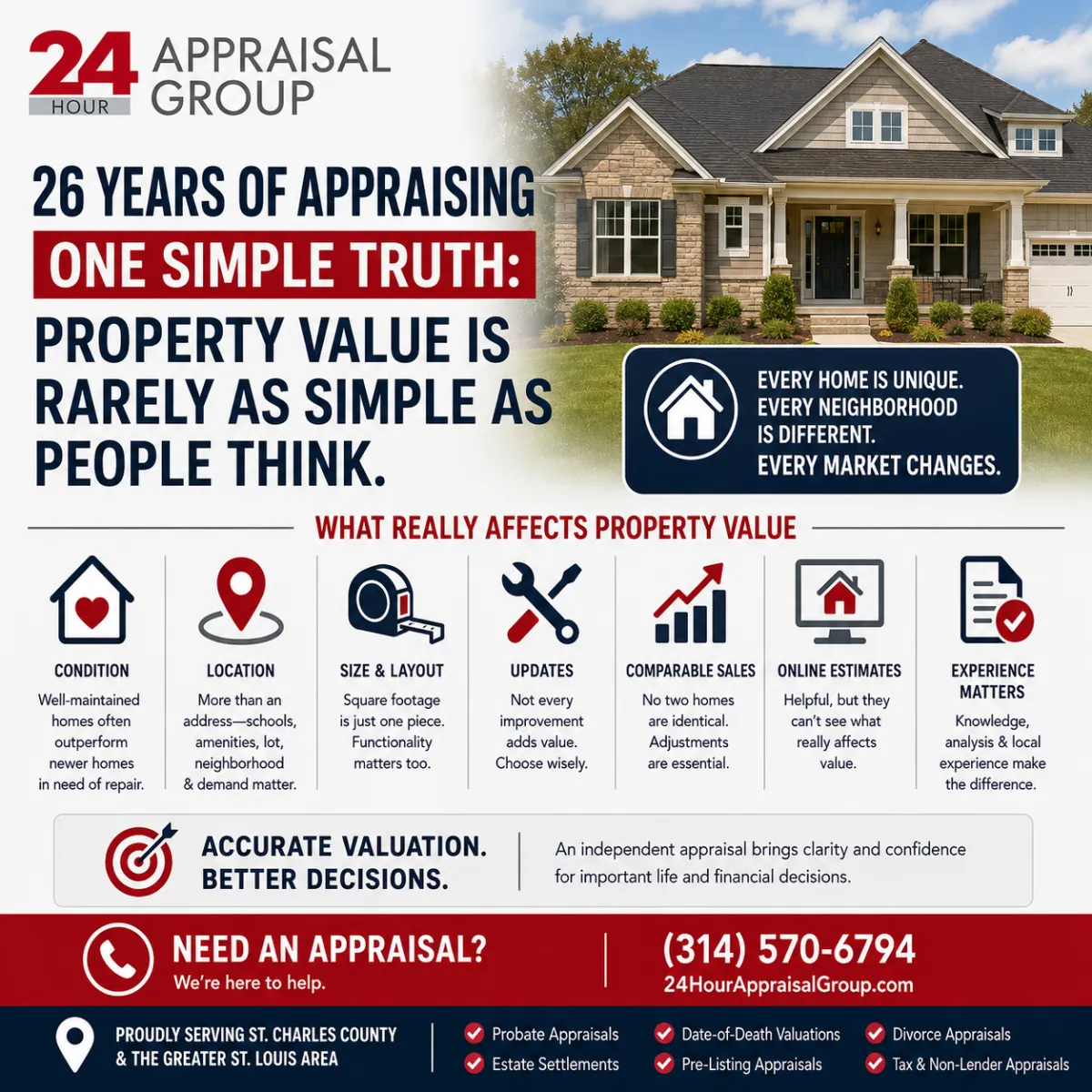
What 26 Years of Appraising Has Taught Me About Property Value
By a St. Charles County Certified Residential Appraiser
After more than 26 years of appraising residential properties throughout St. Charles County and the Greater St. Louis area, I've learned one important lesson:
Property value is rarely as simple as people think.
Many homeowners believe a home's value is determined by its size, its tax assessment, or what a neighbor's house recently sold for.
While those factors may play a role, they only tell part of the story.
Every home is unique. Every neighborhood is different. And every market changes over time.
As a Certified Residential Appraiser, I've appraised thousands of homes for probate, estate settlement, divorce, tax planning, pre-listing decisions, and many other situations. Over the years, I've seen the same misconceptions come up again and again.
Here are some of the most important lessons I've learned about property value.
Property Value Is About More Than Square Footage
One of the biggest misconceptions homeowners have is that larger homes are automatically worth more.
While square footage certainly matters, it is only one part of the equation.
A smaller home that has been well maintained and updated may command a higher value than a larger home with deferred maintenance.
When completing an appraisal, I also consider factors such as:
Overall condition
Floor plan and functionality
Lot size
Location
Quality of construction
Recent updates
Neighborhood demand
Comparable sales
Two homes with similar square footage can have significantly different values depending on these factors.
Condition Often Matters More Than Age
People often ask me whether an older home is worth less than a newer one.
The answer is:
Not necessarily.
I've appraised homes that were more than 60 years old but had been meticulously maintained and updated over time.
I've also appraised much newer homes that required significant repairs.
As an appraiser, I don't simply look at a home's age—I evaluate its condition.
Items such as the roof, HVAC system, windows, plumbing, electrical systems, flooring, and overall maintenance can have a meaningful impact on value.
Buyers Don't Always Value the Same Improvements
Another lesson I've learned is that not every renovation produces the return homeowners expect.
Many people believe every dollar spent on improvements automatically increases a home's value.
That isn't always true.
Some improvements may improve marketability without adding significant value.
Others may increase buyer demand but only modestly affect the final appraised value.
Every market reacts differently.
The goal isn't simply to spend money—it's to make improvements that buyers in today's market actually value.
Location Is More Than an Address
People often say that the three most important factors in real estate are location, location, and location.
After decades of appraising homes, I can confidently say that's true—but location involves much more than the city name.
Even within the same community, property values can vary based on factors such as:
School district
Subdivision
Lot characteristics
Traffic patterns
Nearby amenities
Buyer demand
Market activity
Two homes located just minutes apart may appeal to very different buyers.
That's why local market knowledge is essential when determining value.
Comparable Sales Require More Than Matching Numbers
Many homeowners assume that if a nearby home sold for a certain price, their home should be worth the same.
In reality, selecting comparable sales involves much more than finding homes with similar square footage.
As an appraiser, I look for properties that are similar in:
Age
Condition
Style
Size
Features
Location
Date of sale
Adjustments are often necessary because no two homes are exactly alike.
A professional appraisal reflects these differences rather than relying on simple averages.
Online Estimates Only Tell Part of the Story
Online valuation tools can provide a general estimate, but they cannot physically inspect a property.
They don't know whether a home has:
A newly remodeled kitchen
An aging roof
Foundation concerns
Water intrusion
Updated mechanical systems
Deferred maintenance
These are all factors that can influence value.
That's why an in-person appraisal often provides a much clearer understanding of what a property is actually worth.
Every Property Has Its Own Story
One of the things I enjoy most about appraising homes is that no two assignments are exactly alike.
Some homes have been in the same family for generations.
Some are being sold during probate or estate settlement.
Others are part of a divorce, tax matter, or financial planning decision.
Every property has its own history, condition, and market position.
Understanding that full picture is what allows an appraiser to develop a well-supported opinion of value.
Why Accurate Valuation Matters
I've seen firsthand how an accurate appraisal can help homeowners make better decisions.
Whether someone is:
Selling an inherited property
Settling an estate
Dividing assets during a divorce
Planning for taxes
Comparing investor offers
Preparing to list a home
Having an independent opinion of value provides clarity during important financial decisions.
It helps replace assumptions with reliable information.
Experience Matters
Technology has changed significantly over the past two decades.
Markets have shifted.
Neighborhoods have evolved.
Buyer preferences continue to change.
But one thing remains constant:
Experience matters.
After more than 26 years of appraising homes throughout St. Charles County, I've learned that every property deserves careful analysis—not assumptions.
Property valuation isn't just about numbers.
It's about understanding the market, interpreting data, recognizing property characteristics, and applying professional judgment developed through years of experience.
The Bottom Line
Property value is influenced by much more than square footage or an online estimate.
Condition, location, comparable sales, buyer demand, market trends, and local knowledge all play an important role in determining what a home is truly worth.
Whether you're handling an inherited property, settling an estate, preparing to sell, or simply want a better understanding of your home's value, having an accurate, independent appraisal can help you make informed decisions with confidence.
Need a Professional Appraisal?
At 24 Hour Appraisal Group, we provide trusted residential appraisal services throughout St. Charles County and the Greater St. Louis area. Whether you need an appraisal for probate, estate settlement, inherited property, divorce, tax planning, pre-listing decisions, date-of-death valuations, or other non-lender purposes, we're here to provide an objective opinion of value backed by more than 26 years of local experience.
Before making important decisions about your property, contact 24 Hour Appraisal Group for an appraisal you can trust.
