What Is ARV? Understanding After Repair Value and Why It Matters for Property Valuation
By a St. Charles County Certified Residential Appraiser
If you're selling an inherited home or considering an offer from a real estate investor, you may hear the term ARV, or After Repair Value.
Many homeowners assume ARV reflects what their property is worth today. In reality, ARV represents something very different—and understanding that difference can help you make better decisions before accepting an offer or investing money into repairs.
As a Certified Residential Appraiser serving St. Charles County for more than 26 years, I've seen many homeowners confuse a property's current market value with its potential value after renovations. Knowing the difference is essential, especially during probate, estate settlement, or inherited property sales.
What Is ARV?
ARV stands for After Repair Value.
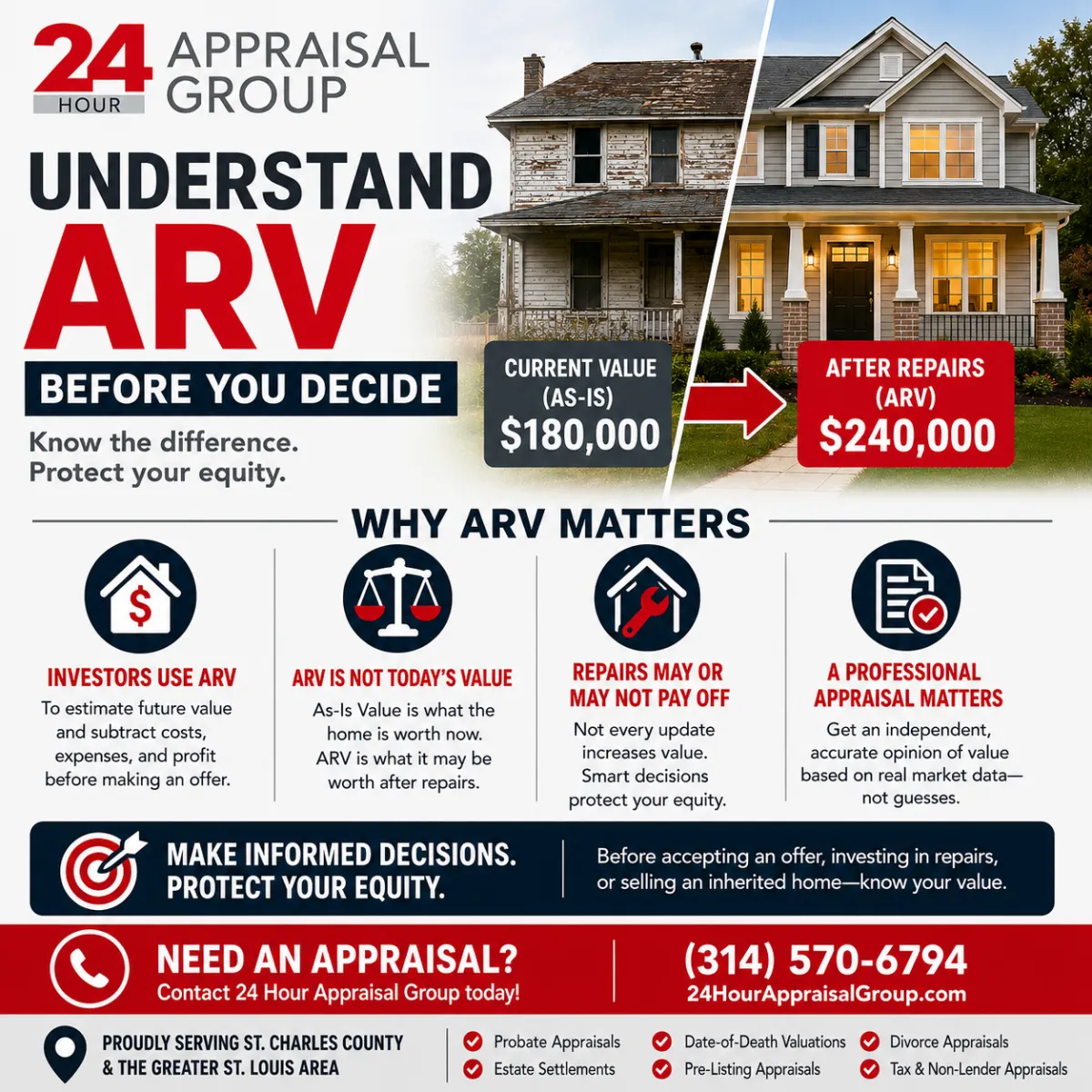
It is the estimated market value of a property after repairs, renovations, or improvements have been completed.
For example:
Current property value: $180,000
Estimated value after repairs: $240,000
In this example, $240,000 is the ARV.
ARV is commonly used by investors, contractors, and real estate professionals to estimate what a property could sell for once improvements are complete.
Why Do Investors Use ARV?
When an investor makes an offer on a home, they are usually looking at much more than the property's current condition.
They must account for:
Repair costs
Holding expenses
Financing costs
Closing costs
Marketing and resale expenses
Desired profit
Because of these costs, investors generally cannot pay the property's full After Repair Value.
Instead, they calculate what they believe the home will be worth after renovations and subtract all anticipated expenses and profit margins before determining what they can offer.
That is why investor offers are often lower than what homeowners expect.
ARV Is Not the Same as Current Market Value
One of the biggest misconceptions homeowners have is assuming that ARV reflects today's value.
It does not.
There are two very different values:
As-Is Market Value
The estimated value of the property in its current condition.
After Repair Value (ARV)
The estimated value after repairs and improvements have been completed.
Understanding which value applies to your situation is critical before making any selling decisions.
Why ARV Matters for Inherited Homes
Inherited properties often need varying degrees of updating.
Some may only require:
Professional cleaning
Fresh paint
New flooring
Minor landscaping
Others may need:
Roof replacement
HVAC repairs
Plumbing work
Electrical updates
Kitchen or bathroom renovations
The amount of work required directly affects the gap between today's market value and the property's potential value after repairs.
Understanding both values helps families compare their options more effectively.
Should You Make Repairs Before Selling?
Not always.
Many homeowners assume that making every repair will automatically increase the home's value enough to justify the cost.
That isn't always true.
Some improvements may provide an excellent return.
Others may cost far more than the value they add.
Before investing thousands of dollars into renovations, it's important to understand:
Which repairs actually influence value
Which improvements increase buyer demand
Which projects may not produce a positive return
Whether selling as-is may be the better option
Every property is different, and the best strategy depends on the home's condition, neighborhood, buyer demand, and the seller's goals.
Why a Professional Appraisal Matters
While ARV is a useful investment tool, homeowners should avoid relying solely on estimates from investors, online calculators, or automated valuation websites.
A professional appraisal provides an independent opinion of value based on:
Current property condition
Comparable sales
Local market trends
Neighborhood characteristics
Buyer demand
Market-supported adjustments
This objective analysis helps homeowners understand what their property is worth today before making important financial decisions.
Common Situations Where Understanding Value Matters
Knowing both current market value and potential future value can be especially helpful for:
Probate
Estate administration
Inherited property
Divorce
Date-of-death valuations
Tax planning
Pre-listing decisions
Non-lender valuation needs
An accurate valuation can help families compare offers, support estate documentation, and make informed decisions with greater confidence.
The Bottom Line
ARV, or After Repair Value, estimates what a property may be worth after renovations are completed. It is a valuable tool for investors, but it should not be confused with a home's current market value.
Before accepting a cash offer, investing in repairs, or selling an inherited home, it's important to understand both the property's as-is value and its potential value after improvements.
A professional appraisal provides an independent, well-supported opinion of value that can help you evaluate your options and make informed decisions based on facts—not assumptions.
Need an Appraisal for an Inherited Property?
At 24 Hour Appraisal Group, we provide professional residential appraisals throughout St. Charles County and the Greater St. Louis area for probate, estate settlement, inherited properties, date-of-death valuations, divorce, tax purposes, pre-listing decisions, and other non-lender valuation needs.
Before making important decisions about an inherited home, contact 24 Hour Appraisal Group to obtain an independent opinion of value you can trust.
